
Language Barriers in Business Operations: How POS Can Help
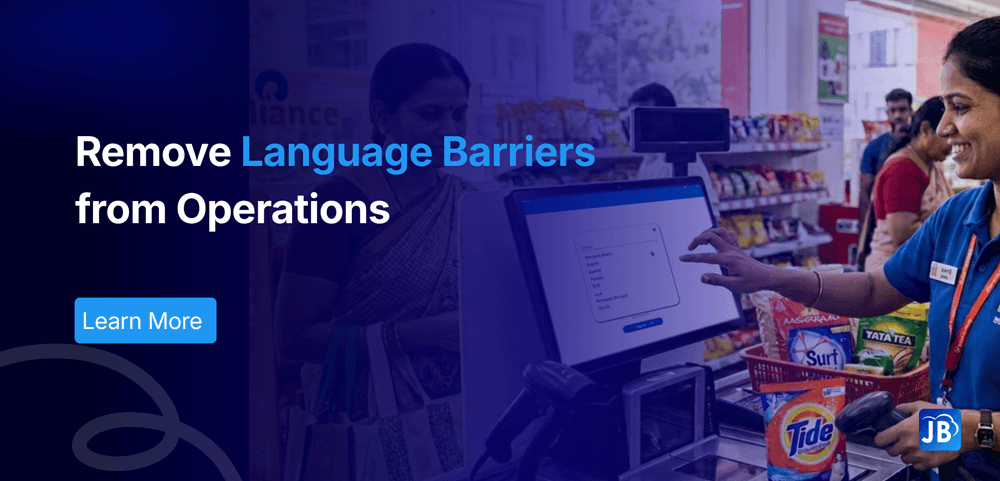
Now-a–days in the business environment, companies are no longer limited by geography. Retail stores, restaurants, and service providers increasingly serve diverse customers and employ multilingual staff. While this opens doors to growth, it also introduces a critical challenge language barriers.
Miscommunication at the billing counter, errors in order processing, and confusion in inventory management can significantly affect customer experience and operational efficiency. This is where modern POS systems with localization capabilities step in as a powerful solution.
In this article, we explore how language barriers impact business operations and how POS localization can transform the way businesses operate globally.
Industry Context: POS Software in a Globalized Retail & Hospitality Landscape
The POS software industry has evolved far beyond simple billing. Today, it plays a central role in managing customer experience, compliance, payments, and analytics across multiple regions.
With globalization, tourism growth, and cross-border commerce rising rapidly, businesses must cater to customers and staff from different linguistic backgrounds. This is especially true in industries like:
- Retail chains expanding across regions
- Restaurants serving international customers
- Franchise businesses operating in multiple countries
- E-commerce and omnichannel sellers
Without proper POS localization, businesses risk miscommunication, billing errors, and lost revenue opportunities.
Understanding Language Barriers in Business Operations
Language barriers affect more than just communication they directly impact revenue, efficiency, and customer satisfaction.
Imagine a scenario where:
- A cashier cannot understand product descriptions in the system
- A customer cannot read the invoice or menu
- Staff misinterpret pricing or tax details
These small issues often lead to larger problems like delayed service, incorrect billing, and negative customer experiences.
In global or multilingual regions like India, the challenge becomes even more complex, with businesses needing to cater to multiple regional languages alongside English.
What Makes POS Localization a Game-Changer?
POS localization transforms how businesses interact with both employees and customers. It ensures that the system adapts to the user not the other way around.
A localized POS system typically offers:
- Language switching for staff interfaces
- Multilingual receipts and invoices
- Region-specific formatting and tax handling
- Culturally relevant UI elements
This adaptability allows businesses to operate seamlessly across diverse environments.
Key Benefits of Using a Multilingual POS System
Stronger Customer Connections
When customers see their preferred language on invoices or screens, it instantly creates comfort and trust. This small change can significantly improve brand perception.
Faster Transactions
Employees spend less time translating or explaining details, leading to quicker checkouts and improved service flow.
Reduced Training Effort
Staff can learn the system faster when it’s available in their native language, reducing onboarding time.
Fewer Costly Errors
Language clarity reduces mistakes in billing, taxation, and order processing.
Improved Business Expansion
Entering new markets becomes easier when your POS system already supports multiple languages and compliance structures.
How Modern POS Systems Eliminate Language Barriers
Technology plays a key role in solving communication challenges.
Dynamic Language Switching
Users can instantly switch between languages without restarting the system, making it ideal for diverse teams.
Visual-First Interfaces
Modern POS systems use icons, color codes, and intuitive layouts to minimize reliance on text.
Automated Customer Communication
Invoices, payment reminders, and notifications can be sent via platforms like WhatsApp in a language the customer understands.
Cloud-Based Flexibility
Cloud POS systems allow businesses to update language settings across all locations in real time.
Step-by-Step: Implementing POS Localization in Your Business
Transitioning to a multilingual POS system doesn’t have to be complex. A structured approach ensures smooth adoption:
Step 1: Identify Language Needs
Analyze your customer base and workforce. Determine which languages are most commonly used.
Step 2: Choose a Scalable POS System
Select a POS that supports multiple languages, currencies, and tax systems.
Step 3: Customize Product Data
Ensure product names, categories, and descriptions are available in relevant languages.
Step 4: Train Your Team
Provide basic training to staff on switching languages and using localized features.
Step 5: Monitor & Optimize
Continuously evaluate how the system improves operations and refine where needed.
Real-World Example: Retail Store in a Multilingual Market
Consider a retail store in a busy urban area serving customers who speak Telugu, Hindi, and English.
Before implementing a localized POS:
- Staff struggled with English-only interfaces
- Customers often asked for explanations of invoices
- Billing errors were frequent
After switching to a multilingual POS system:
- Staff efficiency improved by nearly 30%
- Customer satisfaction increased significantly
- Billing errors dropped noticeably
This demonstrates how POS localization directly impacts business performance.
Expert Insights: Best Practices for POS Localization
Businesses that successfully overcome language barriers follow a few key practices:
- Prioritize languages based on actual customer demographics, not assumptions
- Keep translations simple and contextually accurate
- Ensure consistency across POS, invoices, and digital platforms
- Combine language support with visual cues like icons for clarity
- Regularly update language settings as your business expands
Localization is not a one-time effort, it evolves with your business growth.
How Just Billing Solves Language Barriers
When it comes to overcoming language barriers in business operations, Just Billing offers a powerful, scalable solution designed for modern businesses.
Just Billing’s POS system is built with multilingual capabilities, including support for languages like Arabic, enabling businesses to serve diverse customer bases effortlessly.
What makes it particularly effective is how it integrates language support with other advanced features:
- Multilingual interface for staff ease-of-use
- WhatsApp invoices that can be understood across regions
- Multi-currency support for global operations
- Smart tax ID capture for country-specific compliance
- Seamless integration with platforms like Swiggy and Zomato
- Centralized back-office for managing multi-location operations
Beyond just language support, Just Billing ensures that every part of your business,from billing to reporting, operates smoothly, regardless of geography.
If your business is aiming to scale globally or improve customer experience locally, adopting a POS like Just Billing can be a game-changer.
Conclusion
Language barriers are more than just communication issues, they are operational challenges that can limit growth and efficiency. In a competitive business environment, overcoming these barriers is essential.
POS localization provides a practical and scalable solution by enabling seamless communication, reducing errors, and enhancing customer experience. Whether you run a retail store, restaurant, or multi-location business, investing in a multilingual POS system can significantly improve your operations.
With advanced features and robust localization capabilities, solutions like Just Billing empower businesses to operate confidently across languages and regions.
FAQ's:
Language barriers in POS systems occur when users cannot understand or operate the system due to language differences, leading to errors and inefficiencies.
It improves communication, reduces errors, enhances customer experience, and supports business expansion into diverse markets.
Yes, advanced POS systems allow users to switch between multiple languages based on their role or preference.
It enables customers to view invoices, menus, and receipts in their preferred language, increasing trust and satisfaction.
Just Billing offers multilingual interfaces, global payment support, and localized compliance features for seamless operations.
Search for article
Popular Posts
Download Our App
Share the Post
Explore our POS Software
Retail Billing Software
Super market, Grocery, Electronics, Gift Shops & Stationery
Restaurant Billing Software
Take away, Self service, Ice cream parlor, Coffee shop, Bakery
POS for Service Business
Accountant, Lawyer, Consultant, Photographer
Join Our Newsletter
Receive the latest blog posts, industry insights & exclusive Just Billing updates directly to your inbox.