

How Multilingual POS Improves Staff Adoption
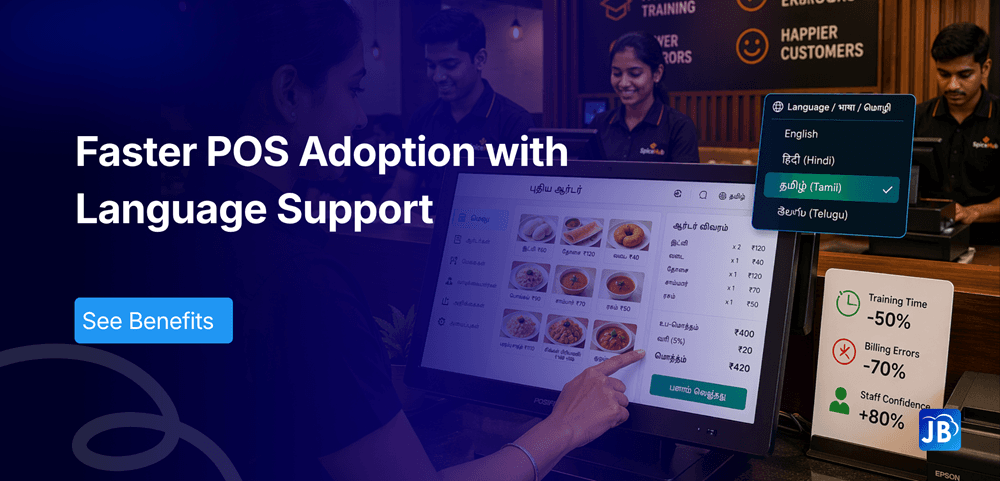
Walk into any modern retail store or restaurant today, and you’ll notice one thing instantly that is diversity. Staff members often come from different linguistic backgrounds, especially in fast-growing markets like India and the Middle East. While this diversity is a strength, it also introduces a silent operational challenge: POS training language barriers.
Many businesses invest in advanced POS systems but overlook a critical factor whether their staff can comfortably use them. The result? Slow onboarding, frequent errors, and underutilized features.
This is where multilingual POS adoption becomes a game changer.
Industry Context: POS Software in Retail & Restaurants
The POS software industry has evolved rapidly, moving beyond billing into complete business management systems. Today’s POS solutions handle payments, inventory, customer engagement, analytics, and integrations with delivery platforms.
However, despite technological advancements, usability remains the biggest adoption barrier.
Studies suggest that nearly 40–60% of software implementation failures are linked to poor user adoption rather than technical limitations. In retail and restaurant environments where staff turnover is high and training time is limited this problem becomes even more critical.
A POS system that employees struggle to understand directly impacts service speed, customer experience, and revenue.
What is a Multilingual POS System?
A multilingual POS system allows users to operate the software interface in multiple languages. This includes menus, buttons, reports, invoices, and even training prompts.
Instead of forcing employees to adapt to the system, the system adapts to them.
For example, a cashier more comfortable in Hindi, Tamil, or Arabic can switch the interface instantly, reducing confusion and increasing confidence.
Why Language Matters in POS Training
Training staff on a POS system isn’t just about teaching features, it’s about building confidence. When employees are trained in a language they understand well, they learn faster and make fewer mistakes.
Imagine onboarding a new staff member who struggles with English-based interfaces. Even simple tasks like billing, applying discounts, or managing returns can become stressful.
Now imagine the same system in their native language. The learning curve drops dramatically.
Businesses often notice three immediate improvements:
- Faster onboarding time
- Reduced dependency on supervisors
- Higher employee satisfaction
This directly translates into smoother daily operations.
Key Benefits of Multilingual POS Adoption
Faster Staff Onboarding
In industries like retail and food service, quick onboarding is essential. A multilingual POS significantly reduces training time by making the interface intuitive.
New employees can start working confidently within hours instead of days.
Reduced Billing Errors
Language confusion is a major cause of billing mistakes. Misinterpretation of buttons or instructions can lead to incorrect transactions.
A language-friendly POS minimizes these risks, improving billing accuracy and customer trust.
Improved Productivity
When employees don’t have to pause and think about what each option means, their workflow becomes seamless. This leads to faster checkouts and better service.
Better Employee Retention
Employees are more likely to stay in environments where they feel comfortable and empowered. A POS system that speaks their language contributes to a positive work experience.
Enhanced Customer Experience
Confident staff provide faster and more accurate service. This reduces waiting times and improves overall customer satisfaction.
Real-World Use Case
Consider a mid-sized restaurant chain operating across multiple cities in India. Their workforce includes staff who speak Hindi, Tamil, Telugu, and English.
Before adopting a multilingual POS, training sessions took 3–5 days, and errors during peak hours were common.
After implementing a multilingual system:
- Training time dropped by nearly 50%
- Billing errors reduced significantly
- Staff confidence improved noticeably
The result? Faster service and higher customer ratings.
How to Successfully Implement a Multilingual POS
Adopting a multilingual POS isn’t just about enabling languages, it requires a thoughtful approach.
Understand Your Workforce
Identify the primary languages spoken by your staff. Prioritize the most commonly used ones to maximize impact.
Simplify the Interface
Even with multiple languages, the interface should remain clean and intuitive. Avoid clutter and ensure consistency across languages.
Provide Hands-On Training
Allow employees to practice in their preferred language during onboarding. This reinforces learning and builds confidence.
Monitor and Optimize
Track performance metrics such as billing speed, error rates, and training duration. Use this data to refine your approach.
Expert Insights: What Businesses Often Miss
Many businesses assume that training alone can solve adoption challenges. However, training has limitations especially in high-turnover environments.
Experts recommend focusing on system usability rather than training intensity.
A well-designed multilingual POS reduces the need for repeated training sessions and ensures long-term efficiency.
Another overlooked factor is regional expansion. Businesses planning to scale across different regions benefit greatly from a POS system that supports multiple languages from the start.
How Just Billing Solves This Challenge
Just Billing is designed with real-world business challenges in mind, including language diversity.
With built-in multilingual support, including Arabic and regional adaptability, it ensures that staff across different locations can use the system comfortably.
Beyond language support, Just Billing offers:
- Smart payment integrations (cards, Stripe, PayPal, in-store)
- Real-time Profit & Loss insights
- Seamless integration with Swiggy and Zomato
- WhatsApp invoices and automated reminders
- Multi-currency and country-based tax compliance
- QR menu for contactless ordering
Its intuitive interface combined with multilingual capabilities ensures high POS adoption rates with minimal training effort.
If you’re looking to simplify staff onboarding and improve operational efficiency, explore how Just Billing can help.
Conclusion
In today’s diverse workforce environment, language should never be a barrier to productivity.
A multilingual POS system is not just a feature, it’s a strategic advantage. It simplifies training, reduces errors, improves employee confidence, and enhances customer experience.
Businesses that invest in multilingual POS adoption position themselves for smoother operations and scalable growth.
FAQ's:
Multilingual POS adoption refers to implementing POS systems that support multiple languages, making it easier for staff to use and learn the system.
It allows employees to learn in their preferred language, reducing confusion and speeding up onboarding.
Yes, clear understanding of the interface minimizes mistakes during transactions.
Many modern systems, including Just Billing, support regional and international languages.
Just Billing combines multilingual support with powerful features like integrations, analytics, and automation, making it a complete business solution.

Search for article
Popular Posts
Download Our App
Share the Post
Explore our POS Software
Retail Billing Software
Super market, Grocery, Electronics, Gift Shops & Stationery
Restaurant Billing Software
Take away, Self service, Ice cream parlor, Coffee shop, Bakery
POS for Service Business
Accountant, Lawyer, Consultant, Photographer
Join Our Newsletter
Receive the latest blog posts, industry insights & exclusive Just Billing updates directly to your inbox.