

Payments, Delivery, WhatsApp & eCommerce: Why POS Integration Matters
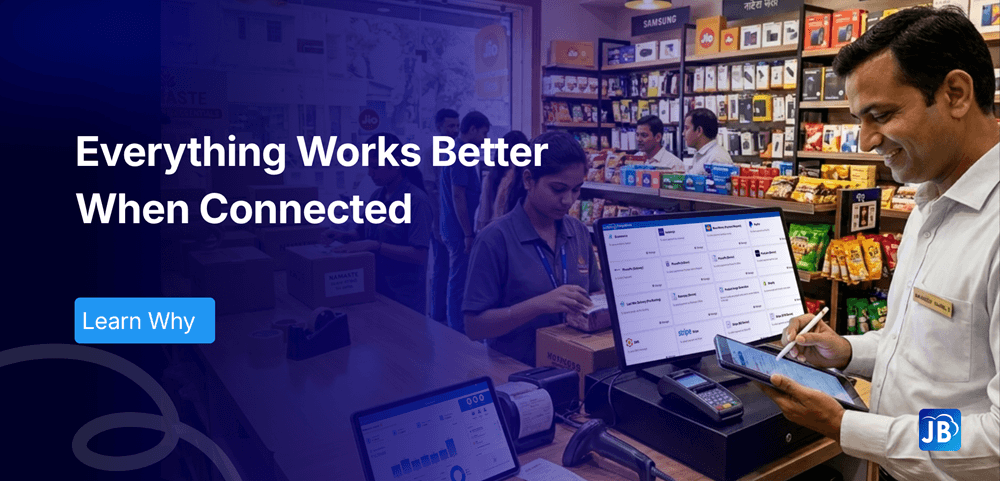
Imagine handling payments on one system, delivery orders on another, customer communication separately on WhatsApp, and online sales on an entirely different platform. This fragmented setup is still common and it’s one of the biggest growth barriers for modern businesses.
This is exactly why understanding why POS integration matters has become essential. A connected POS system eliminates these silos and transforms daily operations into a seamless, automated workflow.
Businesses that adopt integrated POS solutions often report up to 20–35% faster order processing and significantly improved customer satisfaction.
Industry Context: The Rise of Connected Commerce
The POS software industry has rapidly evolved into a central business ecosystem rather than just a billing tool. With India’s digital economy growing at over 20% annually and online orders becoming a daily habit, businesses are expected to operate seamlessly across channels.
Customers today expect:
- Instant digital payments
- Real-time order tracking
- Quick WhatsApp confirmations
- Smooth online and offline shopping
Disconnected systems simply cannot keep up with these expectations. Businesses that rely on manual processes or multiple tools often struggle with inefficiencies and inconsistent customer experiences.
Understanding POS Integration in Simple Terms
POS integration is the process of connecting your billing system with all critical business tools creating a unified system that communicates in real time.
Instead of managing separate systems, everything flows through one platform:
- Orders are automatically recorded
- Payments are instantly updated
- Inventory adjusts in real time
- Customers receive updates without manual effort
This is what defines a true connected POS system.
Why POS Integration Matters More Than Ever
1. Faster and Smarter Payment Processing
Customers expect multiple payment options like cards, UPI, wallets, and international gateways. Without integration, businesses manually track transactions, increasing errors.
With integrated systems:
- Payments are processed instantly
- Transactions are automatically recorded
- Reports are generated in real time
This reduces reconciliation time and improves financial accuracy.
2. Seamless Delivery Platform Management
Managing platforms like Swiggy or Zomato separately can be chaotic. Orders come from multiple sources, leading to confusion and delays.
An integrated POS:
- Syncs all orders into one dashboard
- Eliminates duplicate entries
- Reduces missed or delayed orders
This is especially critical for restaurants handling high volumes.
3. WhatsApp Communication Automation
WhatsApp has become a powerful business tool, especially in India. Customers expect instant updates and communication.
With POS integration:
- Invoices are sent automatically
- Payment reminders are triggered
- Order updates reach customers instantly
This improves customer trust and reduces follow-ups.
4. Real-Time eCommerce Synchronization
Businesses selling both offline and online often face inventory mismatches.
A connected POS system ensures:
- Stock updates instantly across platforms
- No overselling or stockouts
- Unified pricing and product data
This creates a consistent customer experience across channels.
5. Centralized Data for Better Decisions
When systems are disconnected, data is scattered. This makes it difficult to analyze performance.
Integrated POS systems provide:
- Real-time Profit & Loss insights
- Sales trends across channels
- Customer behavior data
These insights help businesses make faster, smarter decisions.
Key Benefits of a Connected POS System
A well-integrated POS system doesn’t just save time, it drives business growth.
Operational Efficiency
Automated workflows reduce manual tasks and allow staff to focus on customers.
Better Decision-Making
Real-time data from all channels helps in tracking sales, inventory, and profitability instantly.
Improved Customer Experience
Faster billing, accurate orders, and instant communication create a smooth buying journey.
Scalability
A connected system makes it easier to expand to new locations or channels without operational complexity.
How Integration Impacts Daily Business Operations
Imagine a customer placing an order online:
- The order is instantly reflected in the POS
- Inventory is updated automatically
- Payment is recorded without manual entry
- A WhatsApp confirmation is sent to the customer
All of this happens within seconds without human intervention.
This level of automation reduces dependency on staff and minimizes errors, especially during busy hours.
Real-Life Use Case: Retail Store Expansion
A growing retail store selling both in-store and online faced constant stock inconsistencies and delayed order processing.
After implementing a connected POS system:
- Inventory synced across all platforms
- Orders were processed 2x faster
- Customer complaints reduced significantly
The result was a smoother operation and a noticeable increase in repeat customers.
Expert Insight: Integration is No Longer Optional
Businesses that still operate on disconnected systems are already falling behind. Integration is not just about convenience, it’s about survival in a competitive market.
A connected POS system helps businesses:
- Make faster decisions
- Improve customer experience
- Reduce operational costs
- Scale without chaos
In a world driven by speed and convenience, integration is the backbone of growth.
How Just Billing Solves the Integration Challenge
This is where Just Billing stands out as a powerful solution.
Designed specifically for modern retail and restaurant businesses, Just Billing offers a fully connected POS system that brings everything under one platform.
With Just Billing, businesses can:
- Accept smart payments including cards, Stripe, PayPal, and in-store transactions
- Integrate seamlessly with delivery platforms like Swiggy and Zomato
- Send WhatsApp invoices and automated payment reminders
- Manage eCommerce and offline sales from one system
- Track real-time Profit & Loss reports
- Handle inventory, customer loyalty, and multi-currency operations
What makes it even more powerful is its integration hub connecting payments, communication, and sales channels effortlessly.
Conclusion
Understanding why POS integration matters is no longer optional, it’s essential for survival and growth in today’s competitive market.
A connected POS system simplifies operations, enhances customer experience, and unlocks new revenue opportunities. Businesses that embrace integration today are better positioned to scale tomorrow.
If your current setup feels fragmented or inefficient, it may be time to upgrade to a unified system like Just Billing and take control of your business operations.
FAQ's:
POS integration matters because it connects payments, orders, inventory, and communication into one system, reducing errors and improving efficiency.
It enables faster billing, accurate orders, real-time updates, and instant communication, leading to higher satisfaction and repeat business.
It syncs orders from platforms directly into the POS, updates inventory, and eliminates manual entry errors.
Yes, it ensures real-time inventory updates across all channels, preventing stock mismatches and overselling.
Just Billing offers an all-in-one integrated solution with payments, delivery, WhatsApp, and eCommerce capabilities, making it ideal for growing businesses.
Search for article
Popular Posts
Download Our App
Share the Post
Explore our POS Software
Retail Billing Software
Super market, Grocery, Electronics, Gift Shops & Stationery
Restaurant Billing Software
Take away, Self service, Ice cream parlor, Coffee shop, Bakery
POS for Service Business
Accountant, Lawyer, Consultant, Photographer
Join Our Newsletter
Receive the latest blog posts, industry insights & exclusive Just Billing updates directly to your inbox.